Tuck MBA Essays and Advice for 2026-2027
Are you targeting Dartmouth’s Tuck School of Business? The Tuck MBA essays for the 2026-2027 admissions season are now available, and the prompts received a subtle refresh. Here’s what changed, along with the updated deadlines.
Tuck requires three essays this cycle, plus optional and reapplicant prompts. The Tuck MBA essays reward self-awareness and fit over flash. At a school this small and collaborative, the admissions committee wants to see your sincere reasons to be there. Strong candidates often stumble by writing technically proficient essays that could belong to any applicant. Specificity and honesty are your edge.
Quick Summary
- The bar at Tuck isn’t just being an impressive candidate on paper. It’s writing essays that only you could have written, and that could only be about Tuck. Generic strength gets rejected here more often than it does almost anywhere else.
- Essay 1 now asks where you need to grow. A real, slightly uncomfortable weakness beats a safe non-answer, and many applicants play it too safe.
- Essays 2 and 3 are about the person, not the professional. Essay 2 wants one true thing your resume doesn’t show, and Essay 3 wants one hard moment of supporting someone, where what you learned outweighs how it turned out.
What Separates the Strongest Tuck MBA Essays from the Rest?
Tuck publishes ample application guidance, including a four-part series on its admissions criteria (smart, accomplished, aware, encouraging) and a detailed walkthrough of each essay. It’s thorough and, frankly, required reading in full. So, rather than repeating it here, we’ve focused this post on the layer where applicants can go wrong. Across hundreds of Tuck applications, we’ve seen otherwise solid candidates make the same avoidable errors. The problem is rarely a weak profile; it’s a capable person who writes essays that have no strong point of view.
Before you write a word, remember that Tuck is small, rural, and fully residential. Nearly everyone lives in Hanover and goes through the program together, which is what makes its tight-knit community more than a brochure line. One of our Tuck-alum consultants put it well on B-Schooled podcast episode #81: it’s a place where everyone is fully committed for two years, and there’s nowhere to hide.
That shapes everything the committee reads for. They aren’t just screening for whether you’re good enough to handle the rigor. They’re asking whether you’ll thrive somewhere you can’t coast, and whether you’ll make the person next to you shine.
How Should You Approach the Tuck Short-Answer Goals?
Your professional goals now live in a short-answer field of 300 characters each, split into short- and long-term goals. These two answers do different jobs. The short-term goal should be concrete and credible; the actual role and impact you want right after graduation.
The long-term goal is where Tuck wants you to reach. The prompt asks about your dream job and the legacy you hope to leave. Patricia Harrison, Tuck’s director of admissions, evaluation and yield, wrote in a post about the goals prompts that she and her colleagues are “especially excited” to read this answer because it reflects how you hope to improve the world through business.
This is not the place to play it safe. So, aim high here. But watch out for the long-term goal that rings hollow. In our experience, a grand but vague goal (“I want to be a transformational leader who reshapes an industry”) comes across as posturing.
Compare that to a specific, purposeful one: “I want to build a rural health system that reaches patients who currently go without.” The second lands as vision. Make sure your long-term answer sounds like a person’s purpose rather than a company mission statement. And because your goals live here, don’t restate them in Essay 1. That essay is about the why, not the what.
How Should You Approach Tuck MBA Essay 1?
Your professional goals are described elsewhere in your application. What led you to those goals and to your understanding of where you need to grow? Why is Tuck the right environment to support that growth and help you achieve your ambitions? (2,000 characters)
Most applicants underestimate how much this essay rides on fit. They treat “why Tuck” as a box to check and write something competent that could describe any strong program. An admissions reader who knows Tuck deeply can feel that on the first pass, and the quiet verdict is, “this person doesn’t understand us.” In a class this small, where every admit shapes the community, that impression alone can sink an otherwise strong candidacy.
Two things separate a strong Essay 1 from a forgettable one.
Name a real weakness
The first is how you handle the growth question. This prompt asks where you need to grow, and nervous applicants often reach for a safe, flattering non-weakness. “I need to sharpen my public speaking.” “I want to become more strategic.” Admissions readers see those constantly, and they signal the opposite of self-awareness.
The whole point of the question is to see whether you can name a true gap without spinning it. A candidate who admits they’ve never managed people, or that they can build a model but struggle to tell the story it supports, is doing exactly what Tuck asked. The discomfort is the signal.
Choosing the right gap is a skill in itself. The best growth areas are real enough that naming them costs you a little, are tied to where you’re headed, and fall squarely within what a Tuck MBA can develop. A weakness unrelated to your goals just fills space, and one that undercuts your basic readiness raises a different worry.
Aim for the honest middle, a capability your next step clearly demands and that you haven’t built yet. A well-identified gap shows you possess the self-awareness that Tuck’s aware criterion is built to reward.
Make your reasons Tuck-specific
The second is why you want Tuck in particular. The trap is drafting a “why Tuck” that sounds like a “why a top MBA.” Strip out the school name, and you’re left with Joe MBA in a Dartmouth sweater, the applicant who wants prestige and a network and could be writing about any program on their list.
Harrison makes this point explicit in Tuck’s essay guidance, writing that the strongest essays are ones where a reader “cannot simply replace the word ‘Tuck’ with any other school name without the essay losing its meaning.”
Clearing that hurdle means naming a real gap of yours and tying it to the part of Tuck that closes it. If you can lead a team but have never managed a budget, say so, then point to the courses or hands-on projects that would build that skill, rather than praising Tuck’s collaborative culture in the abstract.
Tuck’s student ambassadors exist for exactly this. Speak with as many current students and alumni as you can. Ask them why they chose Tuck over comparable programs, what surprised them upon arrival, and what they know now that they wish they’d known going in. Their answers reveal what sets the school apart, and the more sharply you can name that difference, the more your reasons could only be about Tuck.
How Should You Answer Tuck MBA Essay 2?
People are often shaped by experiences that are not fully reflected in their resume. Tell us about an important aspect of who you are that has shaped you as a person. How will your perspective enrich the Tuck community? (2,000 characters)
The likeliest misstep on this prompt is lopsided effort. It has two parts, and most applicants pour everything into the first, who they are, then treat the second, how they will enrich Tuck, as an afterthought. Both halves carry weight, and the essay works only when the second grows organically out of the first.
Show us who you are
Think of it this way. The rest of your application catalogs your accomplishments. This one has a narrower job, which is to let the reader meet the person behind them. The strongest responses go somewhere personal, the kind of thing you don’t usually volunteer. A value that got tested, a part of your background that shaped how you see the world, or a conviction you had to rethink.
It doesn’t need to be dramatic or tragic, only true, and told in enough detail that no one else could have written it. Choose a single thread and follow it deep rather than surveying everything at once. Applicants from crowded feeder industries have the most to gain here. When the reader has seen a dozen near-identical profiles, a vivid, specific story is what makes yours stick out in their mind.
Connect that to what you’ll bring to Tuck
Now, give the enrichment half its due, because this is where essays often thin out. The question is not which activities you’ll sign up for. It’s what the people around you will get from having you there. Tuck is close-knit and residential, so the real contribution happens in study groups, shared dinners, and with the person next to you in class.
The strongest answers grow straight out of the identity you just described, turning the perspective that shaped you into a concrete way you’ll show up for classmates. If your background taught you to bridge people who disagree, show that playing out in a study group under deadline. Point to a club only if it makes the contribution concrete.

How Should You Approach Tuck MBA Essay 3?
Describe a time when supporting another person was not easy or straightforward. What made it difficult, how did you respond, and what did you learn? (2,000 characters)
The Tuck admissions team is blunt about what this essay is. In her essay guidance, Harrison calls it “a relationship essay,” not a leadership essay. That distinction is where most applicants go wrong, because they’ve spent every other essay in their set optimizing for impact and they carry that instinct in here.
Pick a story that taught you something
The part applicants most often shortchange is the last one, what you learned. The prompt moves through what made the situation hard, how you responded, and what it taught you, and that final turn is where weak essays trail off into a tidy line about growth.
Treat the learning as the destination and choose your story for where it leads. The strongest examples changed how you show up for people afterward, whether that’s how you sit with someone in a hard moment or how you tell a friend something they don’t want to hear. If you can’t say what the experience taught you, it’s the wrong story.
This is also why the scale of the outcome matters less than you’d expect. A moment where you backed one person and it half-worked, or fell apart but you stayed anyway, usually produces more honest reflection than a clean victory. Center the story on one relationship, two people at most, because a wider cast pulls the essay toward the leadership register and thins out the intimacy the prompt is after.
Your story can come from anywhere in your life, not just work, so a sibling, a friend, or a teammate in over their head all fit. Steer clear of anything that was simply part of your job description, since managing a direct report through an ordinary project is the role working as designed, not the kind of effort that makes this a story worth telling.
When you reach the reflection, give it room. Tuck wants to know what you learned as much as what you did, so resist ending on a generic lesson and name the specific thing you understand now about supporting someone that you didn’t before.
Should You Write the Tuck Optional Essay?
Please provide any additional insight or information that you have not addressed elsewhere (e.g., atypical choice of references, factors affecting academic performance, unexplained job gaps or changes). Complete this question only if you feel your candidacy is not fully represented by this application. (2,000 characters)
Whether you use this box is itself a judgment call, and judgment is tied to awareness, one of Tuck’s four stated admissions criteria. Use it only for genuine clarity or context. An optional essay stuffed with bonus accomplishments or another pitch about why you love Tuck signals that you can’t tell the difference between what needs to be said and what doesn’t. Most applicants should leave it blank, and doing so costs you nothing.
If you do use it, the move that works is context plus counterevidence plus ownership, in that order. Explain what happened, point to the evidence that better reflects you, and skip the excuses. A reader can feel the difference between “here’s what happened and here’s why it won’t happen at Tuck” and “here’s whose fault it was.”
Keep it short, and if you have a couple of separate points, a quick list beats forcing them into prose.
How Should Reapplicants Approach the Tuck Essay?
How have you strengthened your candidacy since you last applied? Reflect on how you have grown personally and professionally and how your understanding of Tuck has developed. (2,000 characters)
A list of updates is the easy version of this essay and the weaker one. Yes, name the promotion, the higher score, the new scope. But the reapplicant who stands out shows that their understanding of Tuck got sharper, not just their profile. What do you know about the program now that you didn’t a year ago, and how did you come to know it? That kind of answer demonstrates exactly the self-awareness Tuck is grading, and it quietly proves that Tuck was never your backup. Close looking forward.
Using AI for the Tuck MBA Essays
Be careful here, because AI is unusually risky for these essays. Large language models are excellent at producing clean, polished, competent prose, which is precisely the register that gets rejected at Tuck. The essays that work require two things a model can’t fake: a slightly uncomfortable honesty about where you need to grow, and a personal disclosure detailed enough that only you could have written it. Generic polish is what sinks you here, and it’s exactly what a model hands you by default.
Harrison also warns against gaming the character limits, for instance by stringing words together, calling that kind of shortcut a lack of awareness. And in Tuck’s post on the aware criterion, associate director of admissions Tim Neil urges applicants to “set aside pretense or what you think we want to hear and let your true self shine.” A drafting tool that optimizes for what sounds admissions-ready works directly against that.
Used well, AI can be a thinking partner rather than a ghostwriter. It can help you brainstorm which weakness to name, pressure-test whether your short-term goal sounds like a person or a press release, or check whether your Essay 3 story is secretly a hero story. What it can’t supply is your voice, your memories, or the honesty the committee is reading for. Draft those yourself, then bring in a second reader, whether that’s a mentor, friend, or an SBC consultant, to sharpen what’s already yours.
Frequently Asked Questions About Tuck MBA Essays
Should each essay map to a different Tuck criterion?
Not mechanically, but the set should feel deliberate. Tuck reads your essays against four criteria (smart, accomplished, aware, encouraging), and while Essays 1 and 2 lean on awareness and Essay 3 on encouraging, the strongest applications let all four surface somewhere across the three responses and the goals. Once your drafts are done, read them as a group and ask what a stranger would learn about you from the whole. If two essays make the same point, or a core strength never appears, revise for range.
Can Essay 3 be about a friend or family member instead of a work situation?
Yes. Tuck calls this a relationship essay, not a leadership essay, so a personal story is fully fair game. The risk isn’t the relationship, it’s the story you pick. One where everything worked out and you came off looking great will underperform a quieter one where the support was hard to give and the outcome was modest, as long as you show what it taught you.
My short-term goal is basically to keep doing what I already do. Is that a problem?
No. A pivot isn’t required. What Tuck needs is a clear reason the path matters to you and an honest account of where you still need to grow to advance in it. Applicants who stay in their lane and can articulate why are often more convincing than those who manufacture a dramatic switch.
What counts as worth mentioning in the optional essay?
Ask whether a reader would be left with a question you haven’t answered. A gap of several months, a transcript dip, a recommender who isn’t your direct manager, or a recent job change that muddies your timeline all clear that bar. A strong extracurricular, another reason you admire Tuck, or a fourth accomplishment do not, and adding them signals you can’t tell signal from noise. If nothing would confuse a reader, leave it blank.
Need Help With Your Tuck MBA Application?
Getting into a class this small and this selective takes essays that are unmistakably you and unmistakably Tuck, and that’s harder than it sounds when the pressure is to look impressive.
That’s where Stacy Blackman Consulting comes in. Our team includes a former Tuck admissions officer who has evaluated these files firsthand and knows how they land with the committee. Whether you want comprehensive support or targeted feedback, we can help you find the honest, distinctive story that fits Tuck. We offer everything from our All-In Partnership to hourly help with essays, resume reviews, and interview prep.
For a closer look at what works, read sample Dartmouth Tuck essays from past successful admits. The prompts evolve, but what a strong Tuck essay does stays the same: self-awareness, specificity, and fit
Contact us today for a free 15-minute advising session with a Principal SBC consultant.
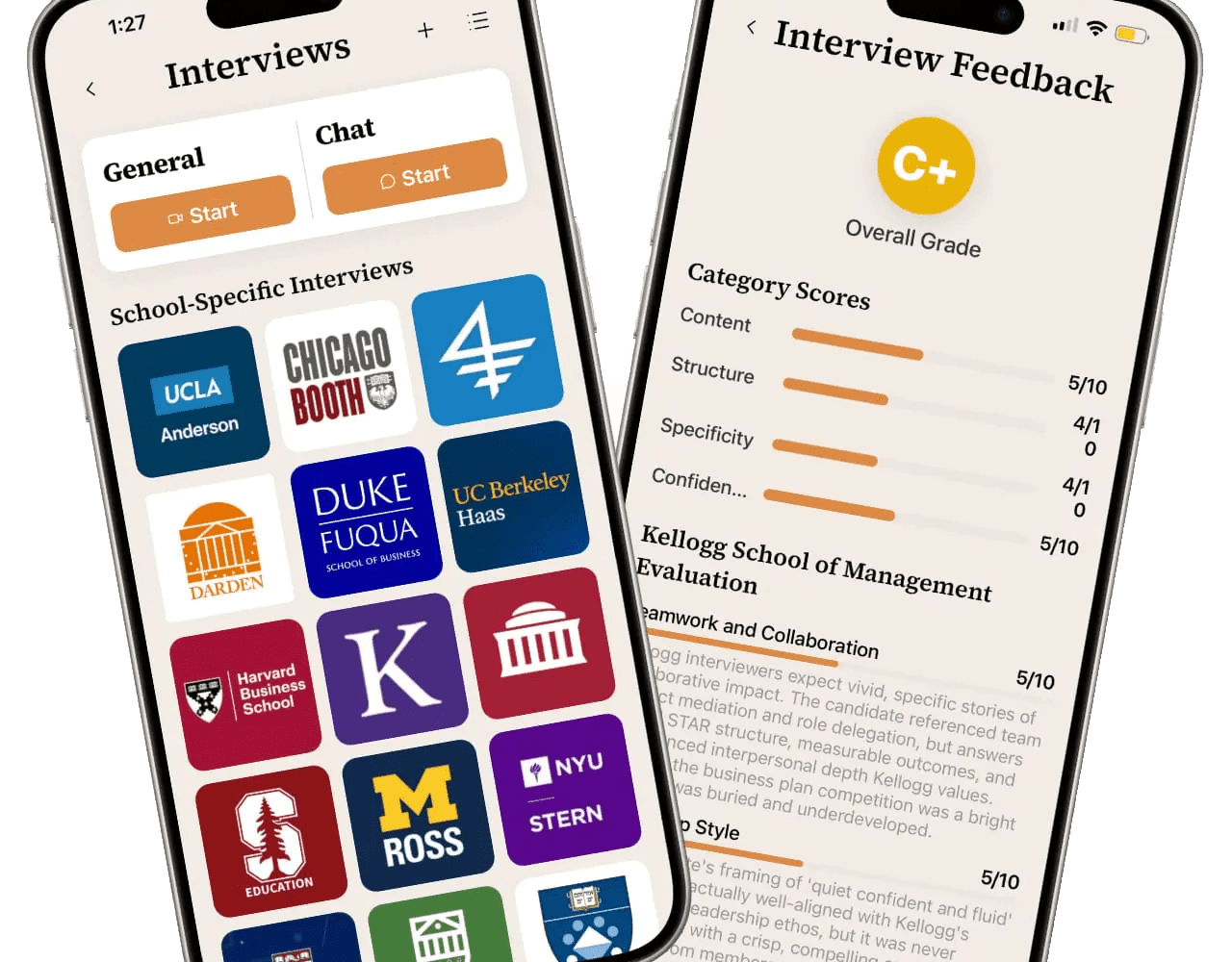
Finally, don’t sleep on our latest product, MBA Launchpad by SBC! It’s your AI-powered admissions assistant, built on 25+ years of real SBC data. Candidacy assessment, school list strategy, essay guidance, and more, available 24/7 in your pocket. All premium features are free until September 1. Download now on the App Store and Google Play.
Here’s a snapshot of the caliber of expertise on our SBC team.














Ashley
Ashley is a former MBA Admissions Board Member for Harvard Business School (HBS), where she interviewed and evaluated thousands of business school applicants for over a six year tenure. Ashley holds an MBA from HBS. During her HBS years, Ashley was the Sports Editor for the Harbus and a member of the B-School Blades Ice Hockey Team. After HBS, she worked in Marketing at the Gillette Company on Male and Female shaving ...
×Pauline
A former associate director of admissions at Harvard Business School, Pauline served on the HBS MBA Admissions Board full-time for four years. She evaluated and interviewed HBS applicants, both on-campus and globally. Pauline's career has included sales and marketing management roles with Coca-Cola, Gillette, Procter & Gamble, and IBM. For over 10 years, Pauline has expertly guided MBA applicants, and her clients h ...
×Laura
Laura comes from the MBA Admissions Board at Harvard Business School (HBS) and is an HBS MBA alumnus. In her HBS Admissions role, she evaluated and interviewed hundreds of business school candidates, including internationals, women, military and other applicant pools, for five years. Prior to her time as a student at HBS, Laura began her career in advertising and marketing in Chicago at Leo Burnett where she worked on th ...
×Andrea
Andrea served as the Associate Director of MBA Admissions at Harvard Business School (HBS) for over five years. In this role, she provided strategic direction for student yield-management activities and also served as a full member of the admissions committee. In 2007, Andrea launched the new 2+2 Program at Harvard Business School – a program targeted at college junior applicants to Harvard Business School. Andrea has also served as a Career Coach for Harvard Business School for both cu ...
×Jennifer
Jennifer served as Admissions Officer at the Stanford (GSB) for five years. She holds an MBA from Stanford (GSB) and a B.S. in Chemical Engineering from University of Illinois Urbana-Champaign. Jennifer has over 15 years experience in guiding applicants through the increasingly competitive admissions process into top MBA programs. Having read thousands and thousands of essays and applications while at Stanford (GSB) Admiss ...
×Davina
Davina received her MBA from Stanford's Graduate School of Business (GSB), with a certificate in Public Management, and her BA in Psychology from UC Berkeley. Davina is an experienced strategic planning leader, facilitator, and business case writer who spent more than 15 years building culture, entrepreneurship, and leadership initiatives across Stanford University and the Stanford Graduate School of Business. She designed ...
×Erin K.
Erin served in key roles in MBA Admissions--as Director at Haas School of Business at UC Berkeley and Assistant Director at Stanford's Graduate School of Business (GSB). Erin served on the admissions committee at each school and has read thousands of applications in her career. At Haas, she served for seven years in roles that encompassed evaluation, outreach, and diversity and inclusion. During her tenure in Admissions at GSB, she was responsible for candidate evaluation, applicant outreach, ...
×Susie
Susie comes from the Admissions Office of the Stanford Graduate School of Business where she reviewed and evaluated hundreds of prospective students’ applications. She holds an MBA from Stanford’s GSB and a BA from Stanford in Economics. Prior to advising MBA applicants, Susie held a variety of roles over a 15-year period in capital markets, finance, and real estate, including as partner in one of the nation’s most innovative finance and real estate investment organizations. In that r ...
×Dione
Dione holds an MBA degree from Stanford Business School (GSB) and a BA degree from Stanford University, where she double majored in Economics and Communication with concentrations in journalism and sociology. Dione has served as an Admissions reader and member of the Minority Admissions Advisory Committee at Stanford. Dione is an accomplished and respected advocate and thought leader on education and diversity. She is ...
×Anthony
Anthony served as the Associate Director of MBA Admissions at the Wharton School at the University of Pennsylvania, where he dedicated over 10 years of expertise. During his time as a Wharton Admissions Officer, he read and reviewed thousands of applications and helped bring in a class of 800+ students a year. Anthony has traveled both domestically and internationally to recruit a ...
×Meghan
Meghan served as the Associate Director of Admissions and Marketing at the Wharton MBA’s Lauder Institute, a joint degree program combining the Wharton MBA with an MA in International Studies. In her role on the Wharton MBA admissions committee, Meghan advised domestic and international applicants; conducted interviews and information sessions domestically and overseas in Asia, Central and South America, and Europe; and evaluated applicants for admission to the program. Meghan also managed ...
×Amy
Amy comes from the Wharton School of the University of Pennsylvania where she was Associate Director. Amy devoted 12 years at the Wharton School, working closely with MBA students and supporting the admissions team. During her tenure at Wharton, Amy served as a trusted adviser to prospective applicants as well as admitted and matriculated students. She conducted admissions chats with applicants early in the admissions ...
×Ally
Ally brings six years of admissions experience to the SBC team, most recently as an Assistant Director of Admission for the full-time MBA program at Columbia Business School (CBS). During her time at Columbia, Ally was responsible for reviewing applications, planning recruitment events, and interviewing candidates for both the full-time MBA program and the Executive MBA program. She traveled both internationally and dome ...
×Emma
Emma comes from the MBA Admissions Office at Columbia Business School (CBS), where she was Associate Director. Emma conducted dozens of interviews each cycle for the MBA and EMBA programs, as well as coordinating the alumni ambassador interview program. She read and evaluated hundreds of applications each cycle, delivered information sessions to audiences across the globe, and advised countless waitlisted applicants. ×
Dana
Dana served as Assistant Director of Admissions at Columbia Business School for the Full-Time MBA program and has over 10 years of experience working in higher education. Known as a scrupulous file reader, Dana reviewed countless applications and assisted in rendering final decisions for the Admissions Committee at CBS. While leading information sessions at Columbia and on the road, Dana met and advised myriad applicants� ...
×Holly
Holly worked as a member of the NYU Stern MBA Admissions team for seven years and holds an MBA from NYU Stern. In her tenure as Director of NYU MBA Admissions, Holly worked closely with admissions teams from Columbia, Michigan Ross, UVA Darden, Cornell Johnson, Berkeley Haas, Yale SOM, and Duke Fuqua on recruiting events domestically and internationally. On the NYU Stern admissions committee, Holly conducted interviews, planned and hosted events, and trained staff on reading and interviewi ...
×Photos courtesy of Tuck School of Business
Written by SBC Consultant Amy | Reviewed by Stacy Blackman. Visit our admissions team page to learn more about SBC’s consultants.


